Amboseli is one of the Kenyan parks where self-drive is a genuine option rather than a theoretical one. The park is compact, relatively well-signposted, and wildlife tends to concentrate predictably around the swamp systems. That accessibility makes Amboseli one of the most tempting parks for independent travellers considering whether they need a professional guide at all.
The answer is not a simple yes or no. Self-drive works well in Amboseli under the right conditions and for the right traveller. Guided safari still delivers a materially better experience for most visitors. Understanding the difference helps you decide where you fall.
What Makes Amboseli Accessible for Self-Drive
Amboseli National Park covers approximately 392 square kilometres — compact by Kenya standards. The main wildlife area clusters around the Enkiama swamp system, which draws elephants, buffalo, hippo, and the predators that follow them. That concentration means a self-drive visitor who simply navigates toward the swamps and the open plains around them will encounter the park’s signature wildlife without needing insider track knowledge.
The road from Nairobi to Amboseli is mostly paved via the Emali route, making the approach manageable for a competent driver. The internal park tracks, while dusty and occasionally rough, are generally navigable without extreme off-road experience in dry conditions.
This is why Amboseli attracts more self-drive visitors than the Masai Mara, where regulations effectively require a professional guide for game drives inside the reserve.
Where Self-Drive Gets Complicated
Road conditions in Amboseli change significantly with rainfall. The final approaches to park gates can be rough, and the tracks around the swamp become genuinely muddy after rain. A standard saloon car will struggle in wet-season conditions; the park’s own guidance recommends a 4×4 during rainy months, particularly if you want to access the swamp edge tracks and the less-used circuits.
Navigation without local knowledge means relying on downloaded maps and signage — functional in most of the park but less reliable on the less-used tracks that often hold the best wildlife. Swamp detour routes, seasonal access points, and the locations where particular animal families spend different parts of the day are information that an experienced guide carries without thinking and that a self-drive visitor needs to research in advance.
There is also the question of wildlife interpretation. Amboseli’s elephants are perhaps the most studied population on the planet, with individual identification catalogued over decades by researchers. A self-drive visitor sees elephants. A visitor with a knowledgeable guide sees Amboseli’s named matriarchs, understands their social structures, and watches specific behavioural cues that explain what the herd is doing and why.
Vehicle Quality: A Non-Negotiable
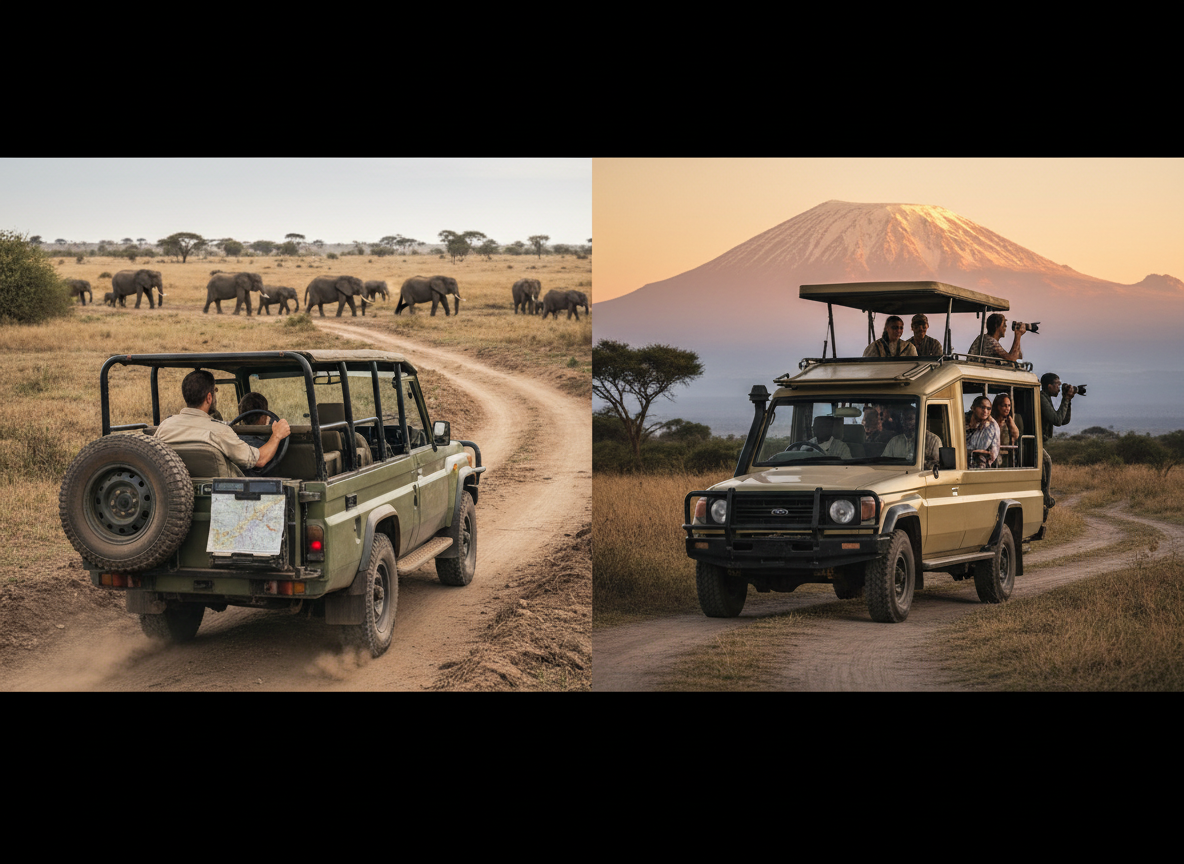
Self-drive is only as good as the vehicle you bring. Amboseli’s tracks require adequate ground clearance, reasonable suspension, and reliable tyres. The dust in the dry season is intense and hard on air filters; the mud in the wet season is sticky and unforgiving.
Guided safari vehicles are built or converted for safari work — elevated seating for better sightlines, roof hatches for photography, strengthened suspension, and drivers who understand what the vehicle can and cannot handle on difficult terrain. A rental car that looks adequate on paper can quietly limit what you can access and how comfortable the drive is.
If you intend to self-drive, invest in the right vehicle. A compromised vehicle in pursuit of saving money on a hire often costs more in stress and limited access than the vehicle upgrade would have.
Cost: The Real Calculation
The apparent cost saving of self-drive over guided safari is real but often smaller than it looks on a spreadsheet.
Self-drive expenses include: vehicle hire (USD 80 to 200 per day for a suitable 4×4), fuel (USD 50 to 100 per day), park fees (currently around USD 40 to 70 per adult per day at Amboseli), and any navigation or recovery margin you should budget for contingency.
Guided safari typically rolls the vehicle, guide, and logistical management into a package. At quality safari camps, the guide cost is often included in the all-inclusive rate, meaning the effective additional cost of guided game drives is lower than it appears when compared to a standalone guide hire.
The calculation also does not account for the value of what a guide provides in terms of wildlife quality and stress reduction. A self-drive visitor who spends three hours of a morning drive navigating and missing sightings while a guided visitor’s expert driver positions them for optimal encounters has paid a real cost that does not appear on any invoice.
Wildlife Quality: The Honest Gap
This is where guided safari consistently pulls ahead in almost every comparison.
The wildlife quality gap between self-drive and guided safari in Amboseli is not primarily about access — both reach the same park — but about interpretation, positioning, and timing. A trained guide knows that a particular leopard has been seen in the fever tree grove at the southeastern end of the swamp for three consecutive mornings. A guide reads the body language of a cheetah resting near a termite mound to assess whether she is about to hunt. A guide knows that a family group of elephants active near the swamp edge in the afternoon is more likely than not to include a bull that habitually joins them at a specific location.
None of this knowledge is available to a self-drive visitor from a map or an app. It comes from years in the field, consistent communication with other guides in the park, and a relationship with the specific animals in a specific ecosystem.
In Amboseli in particular — where the elephant families have decades of documented history — this depth of knowledge is one of the main things a professional guide brings that cannot be replaced.
Safety and Park Rules
Self-drive visitors are individually responsible for maintaining safe distances from wildlife, avoiding prohibited off-road driving, respecting park closing times, and managing any emergency that arises. Amboseli’s park authority has specific rules about vehicle behaviour around wildlife; violations carry penalties and, more importantly, risk habituation harm to the animals.
A professional guide carries the responsibility for compliance and, in an emergency, has the communication protocols and field knowledge to manage a breakdown or wildlife incident. That is not a trivial consideration in a park with lions, buffalo, and elephants that occasionally approach vehicles at close range.
The Verdict: Which Works Best
Self-drive in Amboseli is a viable option for experienced independent travellers who: have done multiple African safari trips before, have a suitable 4×4 vehicle, are travelling in the dry season, are comfortable with navigation on unmarked tracks, and are primarily interested in the experience of being in the landscape rather than the depth of wildlife interpretation.
Guided safari is the stronger choice for first-time visitors, families, photographers who want expert positioning, anyone visiting in rainy season, and travellers for whom the quality of wildlife understanding is part of what they are paying for.
The two options are not equivalent. Self-drive gets you into the park; a skilled guide makes that park reveal itself.
Turn this reading into a real itinerary with help from a Kenya-based safari team.
Start Planning Your Safari